A start that did not suggest an easy night
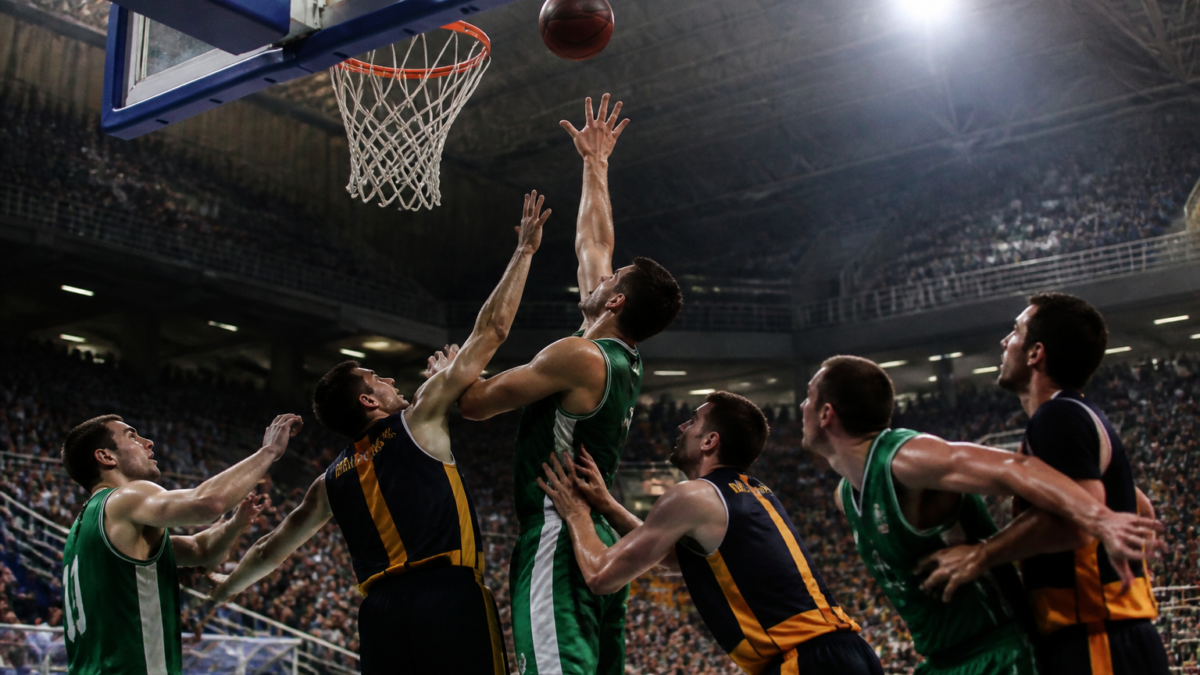
Maroussi came out determined and took an early 10-5 lead, forcing Panathinaikos to look for answers quickly. The visitors continued to find baskets from the perimeter, and at one point in the first quarter they had made four consecutive three-pointers. The game, then, did not begin like a one-sided contest.
The hosts gradually responded. Panathinaikos improved at both ends of the court, found solutions through Francisco and ended the first quarter ahead 23-20. The three-point margin reflected a period in which Maroussi had stayed close, but the hosts had begun to take control.
The picture changed further in the second quarter. Panathinaikos opened up a double-digit lead for the first time, going 40-30 ahead, and went into the locker room with a 46-36 advantage. From then on, the challenge was to maintain the lead without turning the game into an exercise in excessive intensity.
Efficiency near the basket gave them the lead
The numbers from the first quarter of the game help explain how Panathinaikos took control. Although their three-pointers were not often finding the mark — four made from 14 attempts, according to the available figures — the team made the most of its attacks near the basket, shooting 77% on two-pointers. At the same time, just two turnovers in the first half limited Maroussi’s chances to score in transition after an opponent’s mistake.
Dinos Mitoglou made a significant contribution during this stretch, scoring 12 points in as many minutes on the court, while the hosts’ combinations and drives to the basket helped them make the most of their possessions. Rogkavopoulos also provided solutions, both with his scoring and his playmaking. The scoring was not built around a single player, as the final box score also showed.
The third quarter continued in the same vein: Panathinaikos remained in control and entered the final period ahead 68-55. During the game, the lead had reached 15 points, at 60-45. Maroussi continued to find scoring opportunities, mainly through De Souza, but could not change the overall picture.
Rogkavopoulos, Mitoglou and Moraitis shared the spotlight
Nikos Rogkavopoulos finished the game with 15 points, four rebounds and four assists, the highest scoring total for Panathinaikos. Mitoglou added 14 points and six rebounds, while Dimitris Moraitis scored 11. Francisco also reached double figures, with 11 points.
The scoring distribution was linked to coach Željko Obradović’s decision to expand the rotation. Kouzeloglou and Moraitis spent several minutes on the court in the third quarter and provided scoring options. Nunn played 15 minutes, while Lessort played less, according to the game statistics. Hayes-Davis and Bonga did not play, while one of the reports also lists Sloukas as absent.
For Maroussi, De Souza was the top scorer with 18 points and seven rebounds. Dressel followed with 15 points, while Lountzis added 13. The team’s attempt to get back into the game became more evident in the final quarter: an 8-2 run cut the deficit to 70-64, while another account describes the comeback as a 9-0 run. The margin fell to six points, but Panathinaikos responded and did not allow the pressure to continue.
The narrowed lead did not threaten the final outcome
The move to 70-64 gave Maroussi a brief opportunity to push for more, but ultimately did not change the course of the game. Panathinaikos kept its composure, improved its defense at crucial moments and restored a comfortable lead. The final score of 85-72 came after the hosts had held a steady advantage from the second quarter onward.
This development matters mainly as part of the overall picture of the game: the “Greens” did not need to find a last-gasp, close-game solution to win. Maroussi showed that it could remain competitive for long stretches and take advantage of a brief lapse, but the lead built earlier proved sufficient.
For Elias Papatherodorou’s team, the result took its record to 2-6. For Panathinaikos, the win lifted its record to 7-1 after eight rounds. These figures describe the two teams’ progress in the league at that point, without changing the fact that this particular game was decided more by control of the pace than by a constant, possession-by-possession battle.
A win as preparation for the European test
The game against Maroussi came ahead of Panathinaikos’ away game against Valencia in the EuroLeague, scheduled for Tuesday 24/11 at 21:30. Managing playing time and the absence of players were part of Panathinaikos’ preparation for the next game, without preventing the team from securing a win in domestic competition.
This does not mean that the 85-72 result foreshadows the outcome of the European game. The two games belong to different competitions, and the available information does not allow firm conclusions about what will happen in Valencia. It does show, however, that Panathinaikos headed into the trip on the back of a win, with several players having contributed to the scoring.
For the fans at the arena, the night had a clear result, but also a more complex story: Maroussi started strongly, Panathinaikos responded with greater efficiency, and the hosts kept the lead under control despite the late comeback attempt. So the next chapter for the “Greens” is not simply a continuation of their winning run in the league, but a transition to a demanding European game.
The Greek perspective
The game was played in Greece, at Panathinaikos’ arena, in the eighth round of the domestic league.