A confession that changed the agenda before the exam
The crisis did not begin with the Suneung itself, the annual university entrance exam, but with the confession of the top-scoring candidate in a national exam for accountants and tax accountants. According to reports, he admitted that he had photographed the questions with a micro-camera and used a mobile phone to get answers from an artificial intelligence system. His near-perfect performance had already raised questions.
The timing made the revelation particularly explosive: the Suneung was scheduled just a few days later. Suspicions that miniature devices and AI tools could be used to cheat thus spread from another exam to the country’s largest educational institution. It was no longer just a matter of whether a rule had been breached; it was also a test of whether the authorities could protect the integrity of the process.
The case brought a new practical challenge for exams into focus: technology that fits inside a small device can make cheating harder to detect, while allowing answers to be sought from outside the exam room. The available sources do not describe how the AI system worked technically, but they do record the basic method used, according to the confession: taking pictures of the questions and checking answers via smartphone.
From mobile phone alerts to stickers on buttons
The authorities’ response was immediate and extensive. According to the BBC and the Guardian, emergency alerts were sent nationwide on the day of the Suneung, with the aim of detecting phones that had not been handed in. The BBC reports that three alerts were sent between 08:00 and 15:00, and could be heard even on devices set to silent. According to the same report, they were not activated when phones were switched off or in airplane mode.
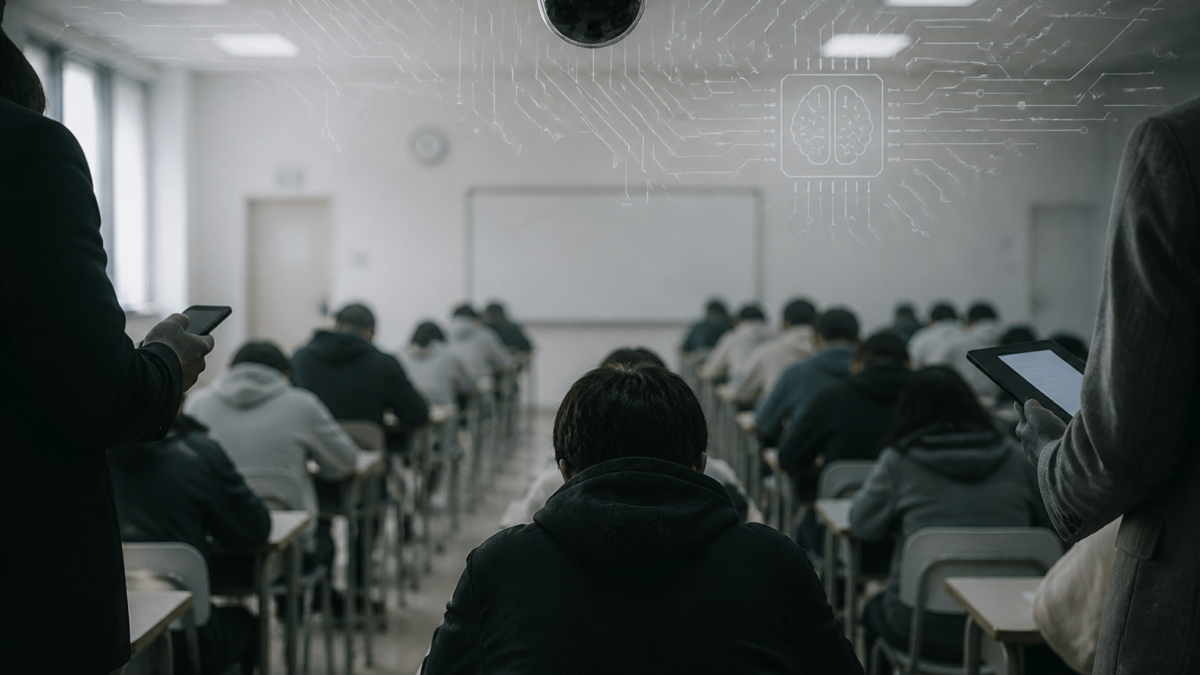
At the same time, candidates were asked to hand in their smart devices and avoid clothes with buttons that could conceal cameras. Where necessary, buttons were covered with stickers. Checks were extended to glasses, watches, collars and sleeves, while restrictions on public Wi-Fi access near exam centres were also reported. The Guardian also describes an increased number of invigilators and checks of bags left in corridors.
The authorities recorded 111 incidents or candidates linked to unauthorised electronic devices. The sources do not use exactly the same wording: the BBC refers to candidates found with devices, while France 24 and the Guardian refer to cases of irregularities. France 24 and the Guardian report that almost half of the cases were detected through the alerts. The BBC notes that this was the first time the national disaster alert system had been used to detect cheating.
“I don’t think I can avoid criticism for failing to prepare in time.”
Choi Kyo-jin, South Korea’s education minister
The pressure of an exam linked to the future
The Suneung carries significance beyond a student’s performance in a school test. Sources describe it as decisive in university selection and, by extension, future career prospects. In a country where exams are closely linked to social and professional mobility, the suspicion that some people may gain an advantage with hidden devices touches on the sense of fairness among candidates and their families.
The scale of the event is also significant. About 500,000 students took this year’s exam, according to the BBC. Reports differ on its duration: France 24 says nine hours and the Guardian eight, while the BBC says it can last up to nine hours. The exam includes an English listening comprehension section, during which, according to the Guardian, flights are even adjusted to reduce noise.
The strictness of the checks, however, comes at a cost to candidates’ experience. The BBC describes students who worried that their regular glasses might be mistaken for smart glasses, as well as one candidate who chose contact lenses to avoid misunderstandings. These accounts do not prove that the checks were unjustified; they do show, however, how efforts to rule out cheating can add uncertainty to an already demanding day.
Resignation and criticism over late preparations
Education Minister Choi Kyo-jin submitted his resignation after the exam was completed, accepting, as he said, responsibility for the authorities’ preparations. President Lee Jae-myung accepted the resignation, according to reports. Choi acknowledged that there was reason for public criticism because, as head of the ministry, he had not ensured preparations were made in time.
Political pressure had been heightened by an earlier response he gave at a parliamentary hearing. Asked whether he was confident the authorities would be able to detect candidates attempting to cheat, he replied that, because of his age, he could not be certain. The statement prompted a backlash. In addition, the minister did not appear at the press conferences before the exam, where the new measures were presented by a deputy minister, according to France 24 and the Guardian.
Education associations criticised the government’s response as late, the Guardian reports. The minister, for his part, said the exam had concluded without serious incidents, without this undoing the responsibility he accepted for what had come before. The resignation, therefore, is not proof that the checks failed on exam day; it records political accountability for how the response to the threat was organised.
The next test is the credibility of the rules
The scale of the measures shows how difficult it is to combine exam security with the smooth participation of hundreds of thousands of candidates. The alerts gave the authorities a way to detect phones that had not been handed in, but their use nationwide also affected people who were not at an exam centre. At the same time, checks of clothing and personal belongings increased surveillance for everyone, not only those suspected of breaking the rules.
The case also has a legal dimension. The Guardian reports that a student had filed a constitutional petition against the decision to hold the exam as scheduled. The court rejected the request, ruling that there was insufficient evidence of irreparable harm. The same Guardian report notes that candidates caught cheating may be barred from retaking the exam for ten years and may face criminal prosecution.
The sources do not describe exactly what changes will follow or mention a new timetable for reforms. What is clear is that the authorities will have to consider how checks can be adapted to a threat involving small devices and artificial intelligence tools without causing unnecessary disruption for candidates who follow the rules. After the education minister’s resignation, the debate is not only about who will take political responsibility, but also about how trust can be maintained in an exam that affects educational and professional paths.