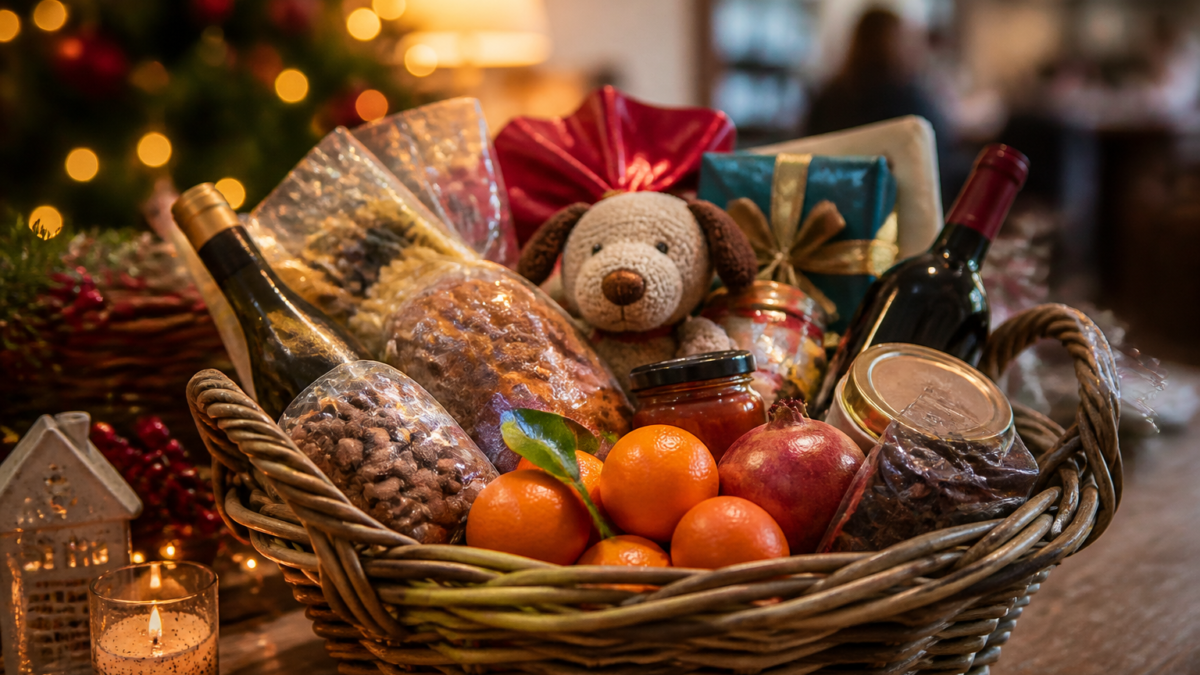
Fourteen days focused on the holiday basket
The “Holidays for All” program is scheduled to run from December 18 to 31. As Deputy Minister of Development Vasilis Spanakis said, it provides for price reductions on more than 300 product codes and includes a total of 26 categories. Another account of the program refers to more than 26 categories, so the available descriptions do not give a completely consistent picture of the list’s scope.
The timing places it squarely in the holiday shopping period. As the presentation of the measure suggests, the aim is to cover products associated both with the Christmas table and with gift shopping. In the same vein, Spanakis invited businesses to take part and said efforts were being made to ensure that the corresponding prices would also apply outside supermarkets. The announcements, however, do not specify which stores will participate or provide a complete list of products.
From meat and sweets to toys
The list presented by the deputy minister includes everyday consumer goods as well as items associated with the holiday table. These include melomakarona, kourabiedes, vasilopita and tsoureki, as well as feta, yellow cheeses, olive oil, rice, soft drinks, beer and chocolate products. Toys are also included in the list, which Spanakis said had been classified as mass-market products.
Meat has a particular place on the list. In remarks on November 21, the deputy minister said reductions of 10% to 15% would apply to pork, beef, turkey and lamb, while he cited a 25% discount on cold cuts. The following day, he said those meats would see “a very significant percentage” reduction, without repeating the same precise range. Thus, the 25% is not described as a uniform discount across all products: according to him, it applies to the majority of product codes, while lower percentages are cited for meat.
“Coordination is needed. The initiative has already started, and I believe it will deliver results.”
Vasilis Spanakis, Deputy Minister of Development
The figures behind the promise of lower prices
The picture presented of the measure is based mainly on two figures: more than 300 product codes and discounts of up to 25%. Spanakis said the majority of products would be discounted by 25%, but the available information does not list the original and final prices for each product. This matters when assessing the measure: the total number of categories and the maximum discount do not, by themselves, show how much the price of each purchase will change.
At the same time, the deputy minister referred to a second initiative covering 1,140 product codes, on which, he said, a 7% discount applies. Another account of the same announcement gives the figure as 7.1%, reflecting discrepancies in the published information. Spanakis said the aim of the new holiday program was to broaden business participation. Its implementation will be judged by which products ultimately make the list and whether the reductions are available at points of sale throughout the program.
Inspections and the causes cited by the government
In discussing prices, Spanakis also cited figures on inspections. He said that 33,000 inspections had been carried out in 2026, fines totaling €33 million had been imposed, and the collection rate had reached approximately 98%. Thousands of complaints submitted through the 1520 hotline are being examined. These figures reflect the Ministry’s account as presented by the deputy minister; the available information does not provide details of the violations to which the fines relate.
He attributed some of the price pressures to fuel prices and supply-chain costs, with particular reference to the energy required for products that need refrigeration. He described the wave of high prices as primarily driven by imports and cited Florina peppers as an example, saying they were being sold at a farmers’ market for the same price as the previous year. On the issue of products being mislabeled as Greek, he said he had already contacted officials at other ministries and that a coordination initiative was under way. He did not, however, give a specific timetable or report any results from this effort.
The political dispute and the question of implementation
The presentation of the price reductions did not focus solely on products and inspection figures. In an interview, the deputy minister defended the government’s measures to tackle high prices, referred to 1,000 investment plans at the ministry and argued that 600,000 new jobs had been created. He also criticized the opposition for its stance toward the government. These are political statements by Spanakis, not an independent assessment of the measures’ effectiveness.
Public discussion also included the program’s promotion on social media. One report said Spanakis had used an AI-generated image with an aesthetic inspired by the game GTA 6 to present the initiative. The same report strongly criticized this choice, contrasting it with the need to tackle high prices. The criticism concerns how the measure was communicated, not the prices that will apply.
The next significant point will be the start of the program and whether the reductions can be checked in stores. Until then, the announcements offer a description of the plan, not a complete picture of its effect on the cost of holiday shopping. The duration, categories and percentages have been announced; the final assessment will depend on the prices consumers actually encounter.
The Greek dimension
The program concerns the market and holiday shopping in Greece, with statements by the deputy minister of development on prices and inspections.