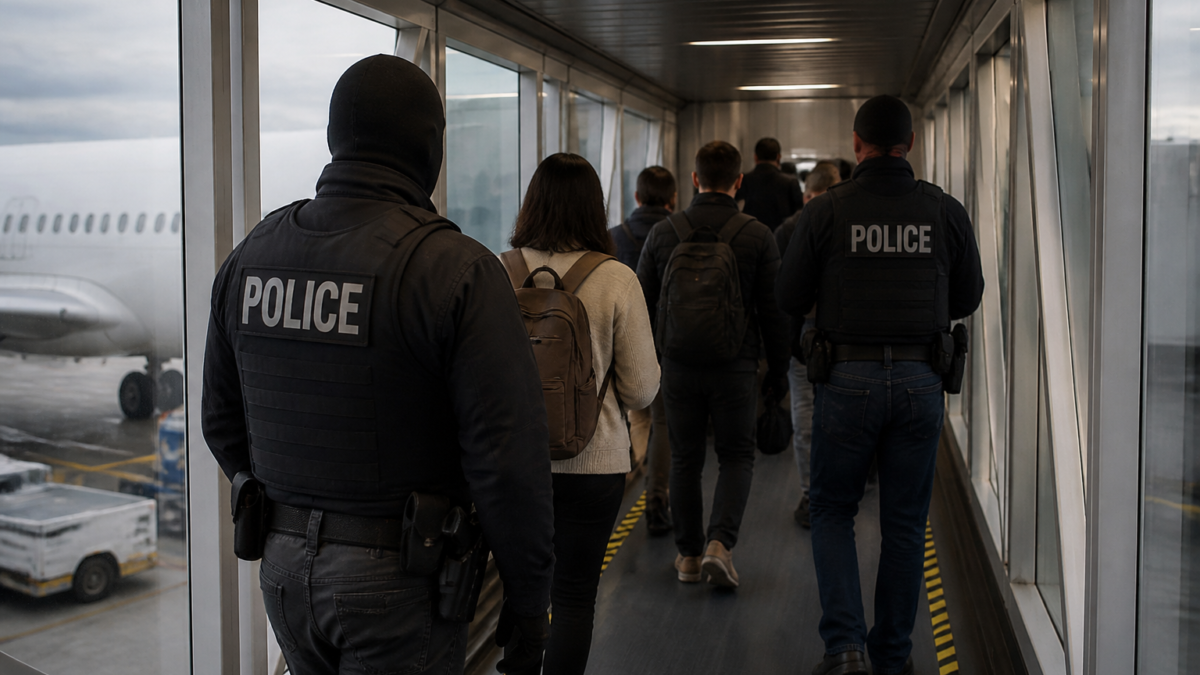
An arrest in front of passengers waiting to travel
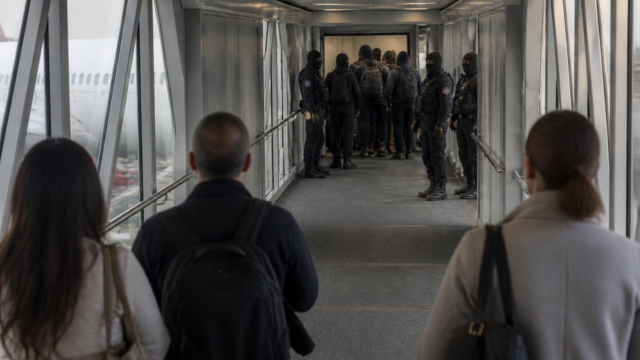
On Saturday, as passengers were preparing to board an Alaska Airlines flight from Seattle-Tacoma International Airport to Los Angeles, agents from the federal immigration agency ICE arrested two people on the narrow jet bridge leading to the aircraft. Videos taken by travelers show the agents surrounding a man and a woman and forcing them to the ground as the other passengers look on. In the footage, people can be heard asking the agents to identify themselves, and a woman can be heard shouting that members of her family have work permits.
ICE said the main target of the operation was Ricardo Larrondo Mendoza, a Mexican national whom the agency accuses of remaining in the United States after his visa expired. Sofia Hernandez Mejia was also arrested. The agency claimed that she, too, had remained after her visa expired and that she threw hot coffee at the agents; according to ICE, she will face a charge of assaulting a federal officer. These are claims by the authorities, not judicial findings.
The video became part of the public dispute
Footage of the incident quickly moved from the boarding gate into the public debate. Videos described by international media show agents with their faces covered and passengers standing nearby. At one point, a child can be heard screaming as agents remove a man through a side exit, while in another video an agent appears to push a bystander who tries to intervene. The footage captures scenes and reactions; by itself, it does not answer every question about what happened beforehand or the legality of each action.
Washington Governor Bob Ferguson called the video “horrifying” and “chilling” and accused ICE of being completely out of control. The federal agency, meanwhile, presented a different account of the bystanders’ conduct: the Department of Homeland Security claimed that some travelers obstructed or assaulted the agents during the arrest. This distinction is critical, as the available sources record conflicting accounts, not an independent final determination of all the events.
“ICE is completely out of control.”
Bob Ferguson, governor of Washington state
Who had access to the jet bridge, and what rules applied?
The political dispute concerns not only the arrests, but also the circumstances in which the operation took place. Ferguson said the state is investigating how the agents reached the boarding bridge and whether a state law he signed in March was violated. According to the governor, the law restricts the use of face coverings by law enforcement officers. Whether it applies in this case, and whether it was violated, remains under investigation; the sources have not presented findings that answer this question.
Alaska Airlines said it had not been notified of the operation in advance and was working with the governor and the Port of Seattle to determine whether established protocols were followed. The port, which operates the airport, said it had conveyed its concerns to the relevant federal authorities, including concerns about the possibility that rules had been violated. The lack of advance notice, as described by the airline, does not in itself prove that the operation was illegal. It does, however, explain why the investigation is also focusing on cooperation or coordination among the agencies involved.
The delay was visible—the impact on travelers was broader
The immediate consequence for those at the airport was disruption to the flight. Departure was delayed by about three hours, and several passengers were transferred to other flights. Alaska Airlines said the incident was distressing for passengers and employees. The governor called on the airline to ask federal immigration authorities to leave the state’s airports and said he would make a similar request to other airlines operating at Seattle-Tacoma.
For travelers, the case raises a practical question: what procedure is followed when a federal operation takes place in a passenger waiting area while boarding is underway? The sources do not fully describe the protocols in force or establish that airlines can prevent a federal operation. They do show, however, that the airline and the port are seeking to determine whether the rules were followed. This distinction matters: public concern over the images is already intense, but responsibility and the legality of the actions require specific evidence.
From the airport to the national debate over immigration
Ferguson was not the only elected official to condemn the operation. Seattle Mayor Katie Wilson called the agents’ tactics unacceptable and contrary to American values, while Port of Seattle Commissioner Hamdi Mohamed focused on the impact of the arrests on families traveling to reunite for the holidays. Demonstrators gathered at the airport on Saturday evening, demanding accountability from federal authorities. The criticism, therefore, concerns both the specific images and the way operations are conducted in a public space with travelers present.
The incident comes as President Donald Trump has announced plans for the largest deportation operation in U.S. history. Al Jazeera links this policy to a broader debate over methods of enforcing immigration laws: it cites a Fox News poll from September, according to which 53% of registered voters believed the government had gone too far. It also reports that Democrats won majorities in both chambers of Congress in the midterm elections and that some senators have proposed restrictions on ICE arrests near airports without a prior judicial warrant. These developments do not determine the outcome of the Seattle case, but they show why it could become a point of reference in a wider political conflict.
The next step is the investigation announced by state officials and clarification from the port and Alaska Airlines about access and coordination rules. The sources do not say where the two people arrested were taken or record any response from them to ICE’s claims. Until more evidence is made public, the central question remains open: whether and how such an operation can be conducted without turning the boarding of a flight into a scene of confrontation.