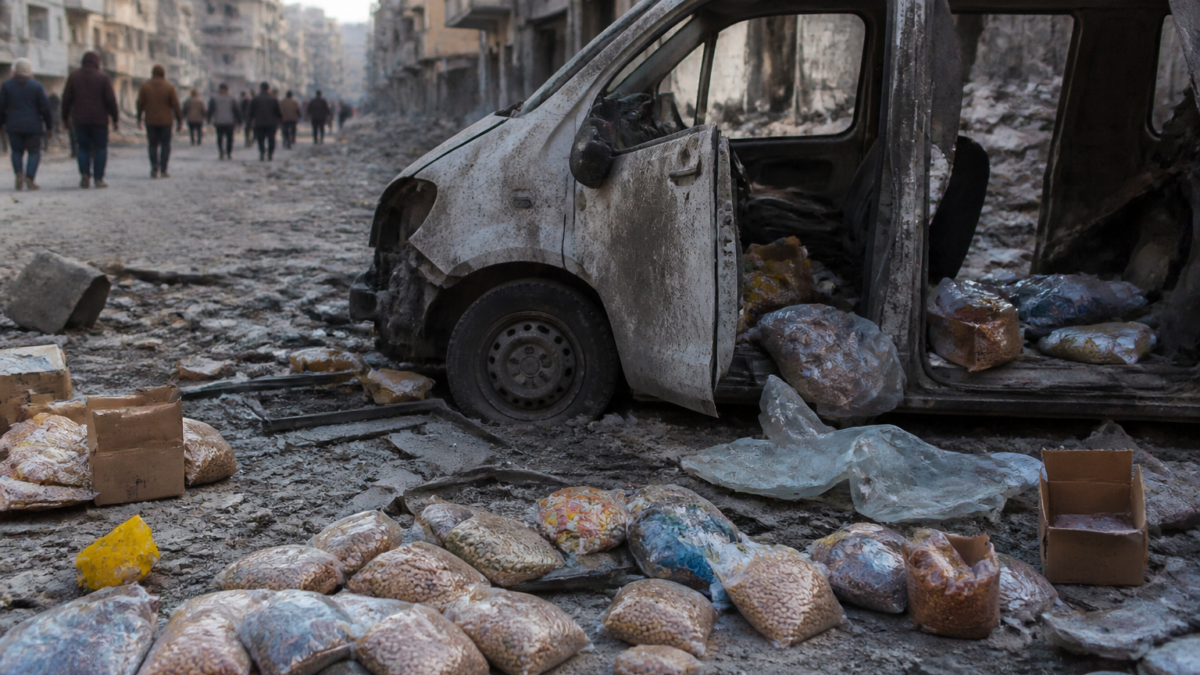
The truck and the food left behind
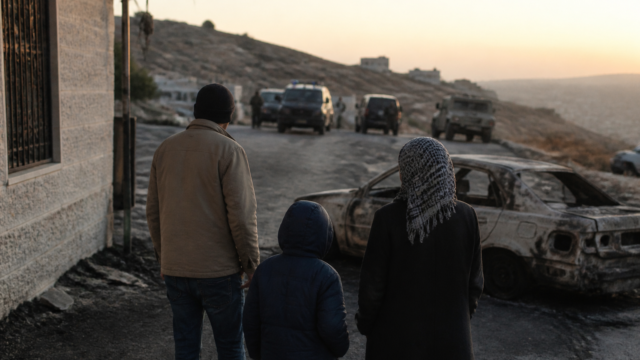
An Israeli strike on Saturday destroyed a vehicle in the Tel al-Hawa area of Gaza City. Three people were killed and several wounded, according to Gaza’s Civil Defense. The vehicle was carrying food for displaced people, said the agency’s spokesman, Mahmoud Bassal. Photographs from the scene showed the wrecked vehicle and food scattered inside it.
An eyewitness, Abu Zein al-Daya, said the vehicle was about to stop to distribute food and water to children when it was hit. The sight of meals left among the wreckage gives the incident a concrete, material dimension: the aid was not an abstract promise, but food already inside the vehicle. However, accounts of the cargo do not, by themselves, answer the question of who was transporting it and who it was intended for.
The WCK logo and the organization’s clarification
Packaged food and documents bearing the World Central Kitchen logo were found inside the vehicle. The organization provides meals in Gaza. Their presence initially gave the impression that the truck was connected to its work. The organization itself, however, said the vehicle was not connected to it. It was also reported that the driver had previously worked for the organization, unlike the other two occupants, who did not work for it.
The distinction is crucial: the documents found do not prove that the vehicle was part of an operation by the organization. At the same time, the fact that the driver had previously worked for WCK does not mean the truck was carrying out one of its missions. The organization did not present it as its own vehicle, while the Israeli military said it bore no markings indicating humanitarian ownership. Thus, the identity of the cargo and its organizational affiliation remain separate questions.
“It was about to stop to distribute food and drinks to the children when it was hit by a missile.”
Abu Zein al-Daya, eyewitness
Conflicting accounts of the dead
The Israeli military announced that it had struck militants in the area. In a separate update, the military said it had sought to target members of Islamic Jihad and that the vehicle was carrying food for its members. This claim had not been independently verified. Islamic Jihad had not commented directly on the strike, while Israeli authorities called false the report that the dead were humanitarian organization workers.
An Israeli officer said one of the dead had previously worked for an international humanitarian organization and was removed after the military provided it with information alleging that he was a “terrorist.” The officer said there was no information that the other two worked for international organizations. This is a claim by Israeli authorities; the available information does not independently verify it. Conversely, WCK’s statement about the driver’s past employment does not confirm the military’s allegation.
A new strike against the backdrop of the 2024 attack
For World Central Kitchen, the incident recalls the 2024 attack in which seven of its workers were killed in an Israeli strike in Gaza. The victims of that attack included citizens of Australia, Britain and Poland. The Israeli military had acknowledged “serious mistakes and breaches of procedure.” In 2026, however, it said it had not found sufficient evidence to proceed with a criminal investigation into that attack.
The two incidents are not supported by the same evidence: after Saturday’s strike, WCK denied that the vehicle was connected to the organization, while members of its staff were killed in the earlier operation. The link between them is the broader issue of the safety of vehicles and people distributing food in a war zone. The sources do not describe any specific new protocol or protective measure introduced after the recent strike. They do, however, record that a truck carrying food became the focus of conflicting accounts of its use and its occupants.
The ceasefire that did not stop the casualties
The strike took place while the ceasefire that came into effect on October 10, 2025, with U.S. support, remains in place. The agreement curbed large-scale fighting but did not bring Israeli attacks to an end. Israel and Hamas accuse each other of violating it. Earlier that week, Israel had carried out a brief ground operation, as well as a strike on a hospital that killed six people; the Israeli military had said the target was a Hamas commander.
For Saturday, Civil Defense announced a total of four people killed by Israeli fire in the Gaza Strip: three in the strike on the vehicle and one by gunfire in Jabalia al-Balad. Shifa Hospital said it received the bodies of all four. Since the ceasefire began, Palestinian tallies have reported more than 1,600 deaths, while the Israeli military has recorded eight deaths on its side: seven members of the armed forces and one civilian contractor.
The conflict also continues over control of territory: Israeli forces now control about two-thirds of Gaza, while Hamas retains a limited area along the coast, according to reports. The war has caused widespread destruction and a food crisis, and the population of the area has been internally displaced. In this environment, the safe transportation of food is part of a broader humanitarian need. The incident leaves unanswered questions about the justification for the strike, the occupants and the status of the cargo.